

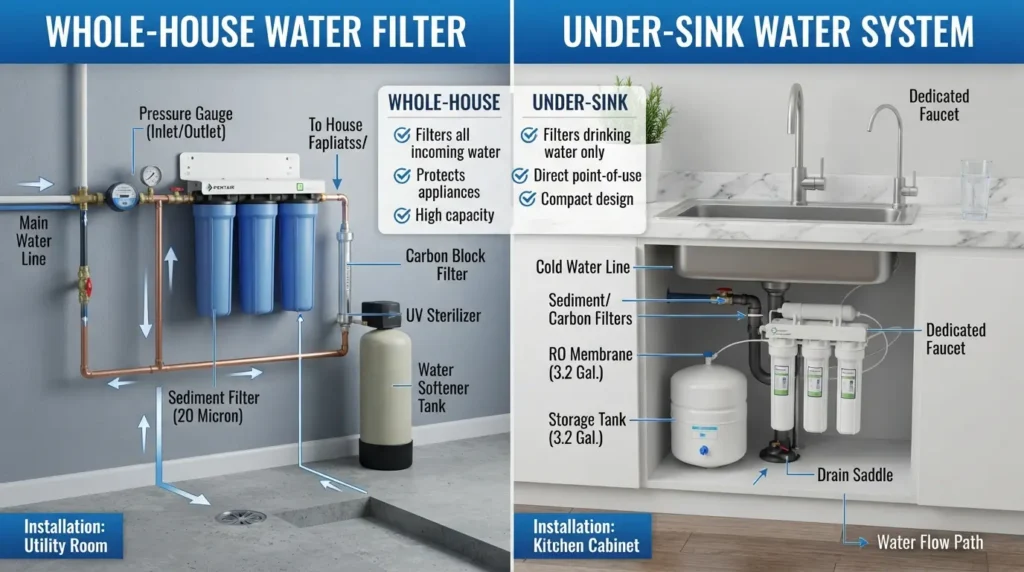
Whether you are dealing with the notoriously hard water of central Massachusetts, aging infrastructure in historic Boston suburbs, or private well vulnerabilities on the Cape, ensuring clean water is a top priority for local homeowners. Many residents quickly realize that basic retail pitcher filters are slow, inefficient, and entirely inadequate for a busy household. Consequently, most people find themselves weighing two heavy-duty paths: Whole-House Water Filters vs. Under-Sink Systems. Both setups offer massive performance upgrades over a simple countertop pitcher, but they serve completely different purposes within your home’s plumbing ecosystem.
Choosing the right system requires analyzing your daily routine, budget, and specific regional water profile. If you only care about pristine drinking and cooking water at a single kitchen faucet, an under-sink system might be your best bet. However, if you are looking to protect your plumbing, appliances, skin, and clothing from contaminants across your entire property, a comprehensive point-of-entry solution is the answer. To find the ultimate setup for your household, partnering with a dependable team like My Family HVAC
ensures your home’s mechanical and water systems run in perfect harmony. Let’s dive deep into how these configurations match up so you can confidently make the right call.
Defining the Contenders: How They Work
To make an educated choice, you must first understand the fundamental structural differences between point-of-entry (POE) and point-of-use (POU) plumbing technology.
Whole-House Water Filters (Point-of-Entry)
A whole-house filter is installed directly inline with your main water supply line, typically right where the water pipe enters your basement or utility closet. Therefore, every single drop of water entering your home passes through the filter before traveling to your water heater, showers, toilets, washing machine, and faucets.
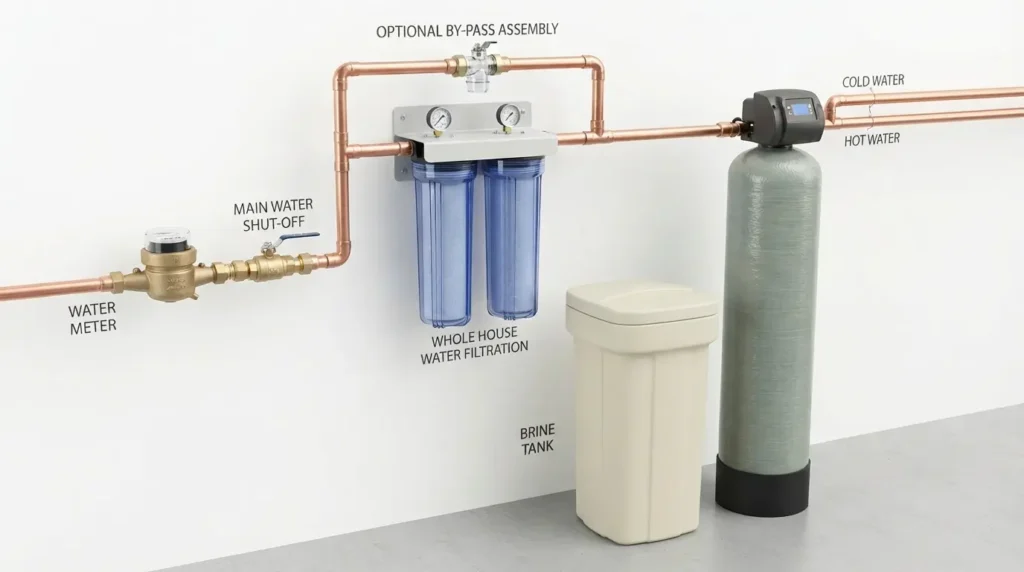
These systems are generally multi-stage, featuring a sediment pre-filter to catch physical particles like rust and sand, followed by heavy-duty carbon media tanks or specialized cartridges designed to strip out chemical impurities at high flow rates. For homeowners looking to completely eliminate taste, odor, and sediment issues at the source, investing in professional whole-house water filtration systems
provides a reliable, long-term solution.
Under-Sink Systems (Point-of-Use)
In contrast, an under-sink water filter targets a single location. It taps directly into the cold water line underneath your kitchen or bathroom counter, routing that specific stream through compact filtration cartridges before delivering it via a dedicated faucet or your main tap.
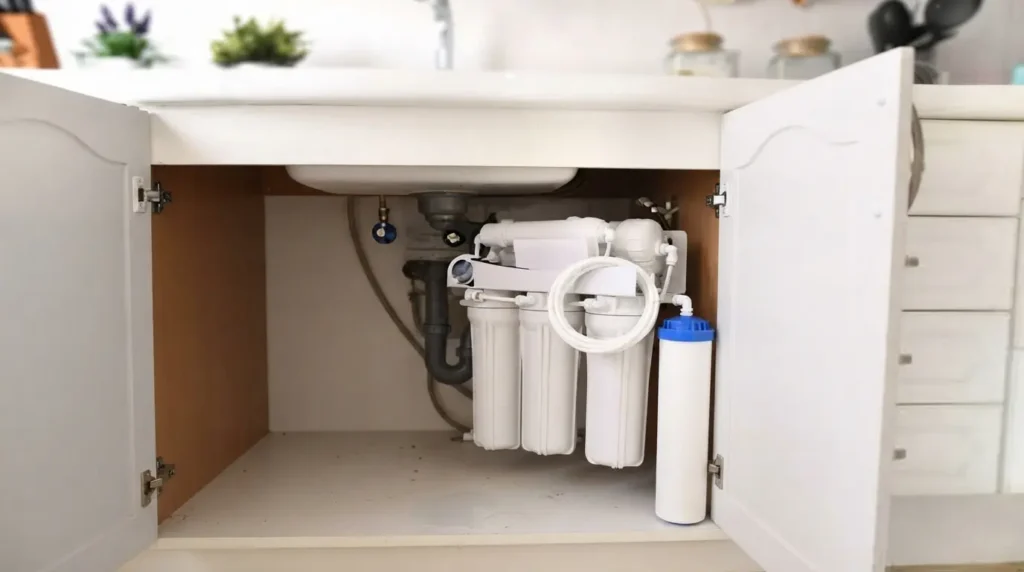
Because these systems don’t have to maintain water pressure for an entire house, they can utilize incredibly dense, slow-flow filtration methods like multi-stage Reverse Osmosis (RO) membranes or ultra-fine carbon blocks. This allows them to achieve an exceptional level of purification for consumption purposes.
Massachusetts Water Realities: Why Local Context Matters
Water quality in the Bay State varies drastically depending on your zip code. Understanding your local profile is essential when deciding between Whole-House Water Filters vs. Under-Sink Systems.
The Municipal Surface Water Challenge
If your home relies on large municipal surface reservoirs—such as the Quabbin or Wachusett Reservoirs supplying the Massachusetts Water Resources Authority (MWRA) network—your water is generally soft and highly treated. However, municipal water faces long transit times through older underground infrastructure. Consequently, it often contains significant levels of:
- Chlorine or Chloramines: Disinfectants used by cities to kill bacteria, which leave behind a harsh chemical taste and odor.
- Lead and Copper: Often leached from aging service lines or older residential plumbing found in historic colonial homes.
- Disinfection Byproducts (DBPs): Trihalomethanes (THMs) that form when chlorine reacts with organic matter.
The Private Well and Groundwater Challenge
Conversely, if you live in rural or semi-rural areas like parts of Worcester County, Western MA, or Southeastern MA, your water likely comes from private or community wells tapping deep underground aquifers. Groundwater presents an entirely different set of headaches:
- Iron and Manganese: These naturally occurring minerals cause stubborn orange, red, or black staining on bathroom porcelain, sinks, and laundry, while giving water a metallic tang.
- Hardness Minerals: High calcium and magnesium levels lead to scale buildup inside your tankless water heater, boiler, dishwasher, and pipes, rapidly shortening appliance lifespans.
- Radon and Arsenic: Bedrock contaminants common in New England that pose long-term health risks if left unchecked.
Head-to-Head Comparison: 6 Crucial Factors
When weighing Whole-House Water Filters vs. Under-Sink Systems, it helps to compare them across the practical metrics that affect your daily life and wallet.
| Feature / Metric | Whole-House Water Filters | Under-Sink Systems |
| Scope of Protection | Complete property coverage (every tap, shower, and appliance) | Single faucet destination (primarily kitchen consumption) |
| Average Initial Cost | High ($800 to $3,500+ including professional plumbing) | Moderate ($200 to $600 average retail and DIY-friendly) |
| Maintenance Frequency | Low (Main media tanks last 3–10 years; sediment filters 6–12 months) | Moderate to High (Filters require replacement every 6–12 months) |
| Flow Rate Impact | Minimal (Engineered to maintain high house-wide water pressure) | Noticeable drop (Often requires a separate dedicated tap due to slow flow) |
| Appliance & Pipe Defense | Excellent (Prevents scale, sediment, and corrosion everywhere) | None (Water reaches appliances completely unfiltered) |
| Contaminant Removal Depth | Great for chemicals, odors, sediment, and heavy metals | Superior for microscopic total dissolved solids (TDS) and PFAS |
When a Whole-House Filter is Your Best Option
Opting for a comprehensive, top-to-bottom home solution is a major lifestyle upgrade. A whole-house filter is overwhelmingly the superior choice if you recognize your household in any of the following scenarios:
1. You Want to Protect Your Expensive Appliances
Modern high-efficiency appliances like tankless water heaters, smart washing machines, and central heating boilers are highly sensitive to sediment, iron, and scale. When hard, untreated water passes constantly through these heating elements, it creates a thick crust of mineral scale that forces the system to work twice as hard.
Furthermore, if you are running automated systems or specialized climate appliances, such as whole-home humidifiers tied directly into your heating installation, mineral scale can quickly clog the internal nozzles and solenoid valves. Protecting these mechanical systems at the main point of entry ensures you preserve your equipment lifespans and avoid premature breakdowns.
2. You Suffer from Dry Skin and Brittle Hair
Unfiltered water impacts more than just your digestive tract. Showering in chlorinated or hard water strips natural oils from your skin and scalp. This frequently exacerbates conditions like eczema, dandruff, and chronic dry skin. Filtering water at its point of entry ensures every shower feels like a spa experience.
3. Your Water Stains Fixtures and Discolors Laundry
If your well water turns your white laundry gray or leaves behind ugly rust rings in your toilet bowls, a localized kitchen filter won’t help you. You need a dedicated iron, manganese, or sediment whole-house system to trap these minerals before they ruin your fabrics and porcelain surfaces.
When an Under-Sink System Makes More Sense
While whole-house filtration is incredibly comprehensive, point-of-use under-sink systems hold a distinct, undeniable advantage under specific living conditions:
1. You Are Pointedly Focused on Ultra-Pure Drinking Water
If your primary goal is removing the maximum possible percentage of microscopic contaminants—including dissolved salts, fluorides, lead, pharmaceuticals, and forever chemicals (PFAS)—a Reverse Osmosis under-sink system is tough to beat. These systems strip water down to its purest molecular state, providing a crisp, bottled-water taste right from your kitchen counter.
2. You Rent Your Home or Have Strict Space Limitations
For those living in a condo, townhouse, or rental unit in Boston or Worcester, cutting into the main water line is usually out of the question. Under-sink systems are highly compact, completely non-destructive, and can be easily uninstalled and packed up when your lease ends.
3. You are Working Within a Strict Initial Budget
If you want pristine drinking water immediately but cannot comfortably afford the upfront cost of a whole-house system and professional plumbing installation, an under-sink unit offers an affordable entry point. Many homeowners can easily install them over a weekend with basic household tools.
Total Property Maintenance: Looking at the Big Picture
Investing in a high-quality water system is part of a larger strategy for property preservation. Just as you routinely change your water filters, you should keep an eye on other underlying infrastructure that handles water, temperature, and ventilation.
For instance, when water quality is poor, your water heater draws significantly more energy to cut through mineral scale buildup. Over time, this compounding strain degrades internal plumbing seals and strains electrical connections throughout your utility closet. To ensure your entire mechanical footprint remains reliable, integrating regular preventative maintenance for your home comfort systems prevents unexpected failures during peak seasonal shifts.
Additionally, keeping your utility spaces clean and free from excess humidity goes hand-in-hand with filtration upkeep. Dust and dampness in a basement can impact filter replacement access and degrade mechanical control boards. If you ever notice stale air or systemic dampness near your main water manifold, looking into indoor air quality solutions like whole-home dehumidifiers can help keep your basement utility zones sterile, protecting your water systems from external contamination.
Can You Use Both? The Ultimate Hybrid Solution
It is worth noting that choosing between Whole-House Water Filters vs. Under-Sink Systems doesn’t have to be an all-or-nothing proposition. In fact, many discerning Massachusetts homeowners choose to combine both technologies to create a comprehensive hybrid solution.
By installing a whole-house carbon or sediment system, you remove the heavy burdens—like chlorine, iron, and coarse sediment—at the property line. This protects your household appliances, preserves your plumbing infrastructure, and cleanses your shower water. Then, by adding a specialized under-sink Reverse Osmosis system in the kitchen, you give that pre-filtered water a final, microscopic polish for drinking and ice-making. An added benefit to this configuration is that the whole-house system extends the lifespan of your under-sink filters, saving you money on cartridge replacements over time.
Final Verdict: Which is Right for Your MA Home?
Ultimately, the decision hinges on your core objectives:
- Choose a Whole-House Water Filter if you own your home, pull from a private well with mineral issues, want to safeguard your plumbing infrastructure, and desire clean, odor-free water from every single shower head and laundry tap.
- Choose an Under-Sink System if your primary frustration is the taste and safety of your drinking water, you live in an apartment or condo, or you want the absolute highest level of purification possible for culinary purposes without a large upfront capital investment.
Take the time to get your water tested locally so you can pinpoint exactly what contaminants reside in your pipes, then select the system architecture that aligns with your household budget and long-term goals.
Ready for Crisp, Clean Water? Call Us Today!
Don’t guess when it comes to your household’s health and plumbing safety. Whether you want to test your home’s water profile or are ready to install a professional point-of-entry system, our expert local team is here to help. Call us today or visit our contact page to schedule your home water quality consultation!