
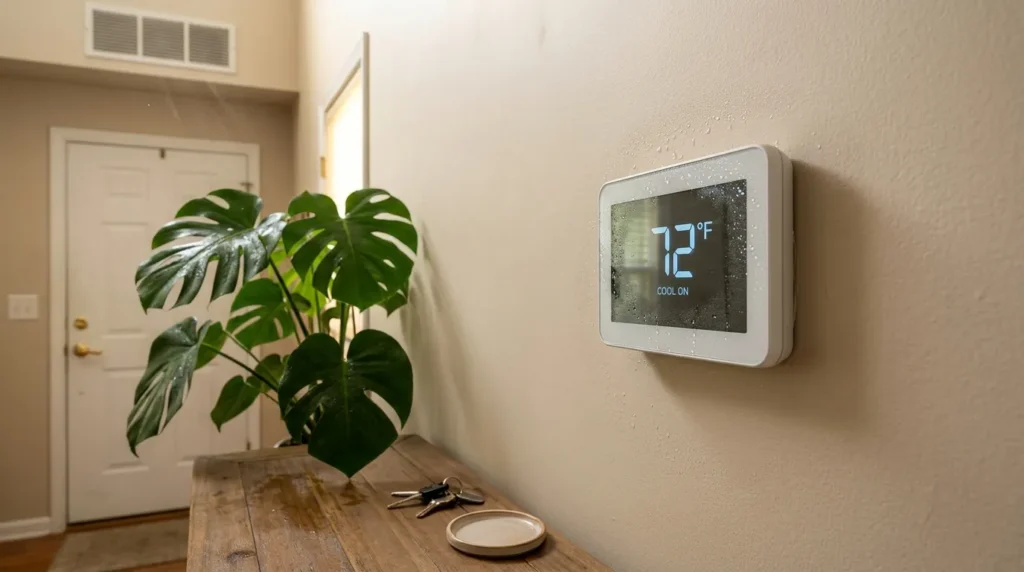
You come home on a sweltering summer afternoon, expecting a crisp, refreshing wall of cool air the moment you step through the front door. Instead, you are greeted by a heavy, sticky atmosphere. Your skin feels clammy, your bedsheets feel strangely damp, and the indoor air feels thick and oppressive. You check your thermostat. The digital display confirms that the indoor temperature is exactly where you set it—seventy-two degrees. The air conditioning system is running, the vents are blowing cold, yet the indoor climate feels more like a tropical rainforest than a comfortable sanctuary.
This creates a deeply frustrating paradox for homeowners. Your cooling system is technically lowering the temperature, but it is failing to manage the moisture. When your house feel humid even with ac on, you are not just dealing with a minor comfort annoyance. This specific symptom is often the first warning sign of underlying, niche systemic problems within your home’s structural shell, mechanical design, or air distribution network.
Ignoring a persistent humidity issue can compromise your family’s respiratory health, destroy your indoor comfort, and even threaten the structural safety of your home. To fix a home that feels like a sauna despite a running air conditioner, we must look beyond basic maintenance and investigate the hidden, systemic failures that cause indoor moisture levels to skyrocket.
The Invisible Balance: Temperature vs. Relative Humidity
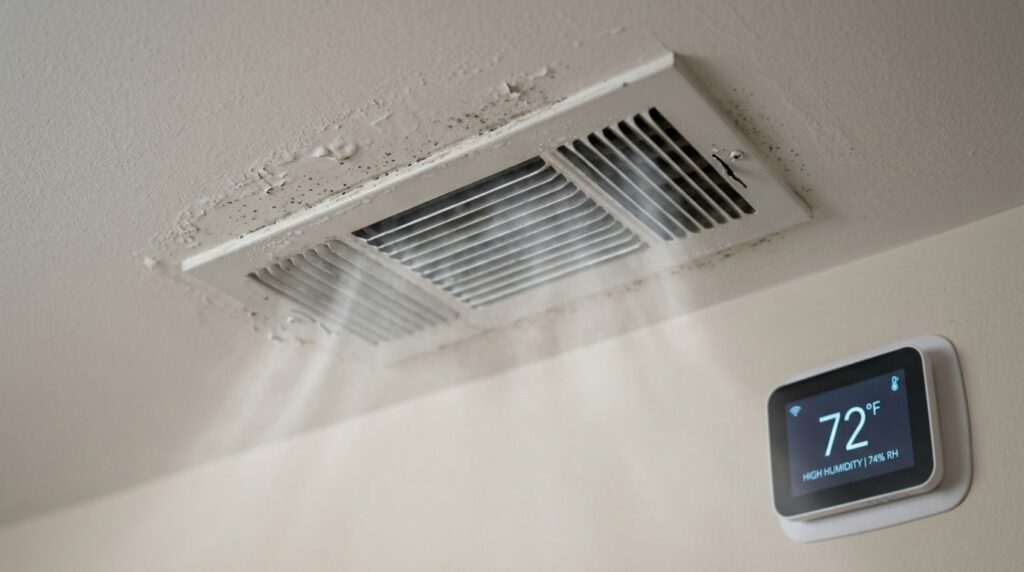
To understand why your house feel humid even with ac on, it is essential to understand how an air conditioner is supposed to work. A standard central air conditioning system has a dual responsibility: it must lower the sensible heat (the temperature you read on a thermometer) and remove latent heat (the invisible water vapor suspended in the air).
As your system pulls warm, moist air from your living spaces through the return vents, it passes that air directly over a freezing cold evaporator coil. When this warm air hits the cold metal, moisture condenses out of the air—much like water droplets forming on the outside of an iced glass on a humid day. This condensation drips into a drain pan and flows outside your home, leaving the air both cooler and drier before it is recirculated into your rooms.
When your home remains sticky despite a low temperature reading, it means the sensible cooling process is outpacing the latent dehumidification process. The temperature drops, but the relative humidity climbs. Relative humidity measures how much moisture the air holds compared to the maximum amount it can hold at that specific temperature. Because cold air cannot hold as much moisture as warm air, lowering the temperature without removing the water vapor actually drives the relative humidity percentage up.
If your indoor relative humidity climbs above fifty-five to sixty percent, your sweat cannot evaporate efficiently from your skin. This is why a home at seventy-two degrees with high humidity feels significantly more uncomfortable and suffocating than a home at seventy-six degrees with a crisp, low humidity level.
Niche Systemic Problems Driving High Indoor Humidity
When a cooling system fails to dry out the air, homeowners often assume they just need a simple filter change or a quick refrigerant top-off. However, when your house feel humid even with ac on, the root cause is frequently a more complex, systemic issue hidden behind your drywall, in your attic, or within the engineering specifications of your HVAC system itself.
The Oversized HVAC System Paradox (Short-Cycling)
In the world of heating and cooling, bigger is definitely not always better. Many homeowners, and unfortunately some inexperienced contractors, believe that installing a larger air conditioning unit will cool a home faster and more efficiently. This misconception is one of the leading causes of chronic indoor humidity problems.
An oversized air conditioner will rapidly blast massive amounts of cold air into your home, satisfying the thermostat setting in a matter of minutes. This rapid cooling cycle is known as short-cycling. Because the system shuts down so quickly, it never runs long enough for the evaporator coil to reach its optimal operating temperature and sustain the condensation process.
The system lowers the room temperature, but it turns off before it can strip the moisture out of the air. The air conditioner must run continuously for at least ten to fifteen minutes for meaningful dehumidification to occur. When an oversized system short-cycling all day long occurs, it creates a cold, clammy, and high-humidity indoor environment. If your current unit is showing these symptoms, it might be time to look into a professional AC Replacement to scale your system correctly to your floor plan.
The Thermostat Fan Setting Trap
A simple, overlooked setting on your thermostat can completely sabotage your air conditioner’s ability to dry out your home. Your thermostat fan setting has two primary options: “AUTO” and “ON.”
When the fan is set to “ON,” the indoor blower motor runs continuously, twenty-four hours a day, regardless of whether the air conditioner is actively cooling the air. When the fan is set to “AUTO,” the blower motor only runs when the system is actively cooling.
If you leave your fan set to “ON,” here is what happens: during a cooling cycle, moisture condenses onto the cold evaporator coil and drips down toward the drain. However, a significant amount of water remains clinging to the fins of the coil when the compressor cycle ends. If the fan continues to run continuously, it blows warm air across that wet evaporator coil, evaporating all of that recently captured water right back into your home’s air stream before it has a chance to drain away. This cycle repeats all day, keeping your indoor humidity levels consistently high.
Negative Building Pressure and Ductwork Leaks
Your home is an interconnected systemic environment. Air that leaves a space must be replaced by air from somewhere else. If your home’s ductwork is leaky, poorly sealed, or improperly routed through unconditioned spaces like attics, crawlspaces, or basements, it can alter the pressure dynamics of your entire house.
If there is a break or disconnection in your return ductwork (the ducts that pull air out of your rooms and back into the AC system), the system will pull air from whatever space the leak is located in. If the return leak is in a hot, humid attic or a damp crawlspace, the air conditioner will draw in incredibly moist, unconditioned air.
Furthermore, because the system is drawing air from outside the living envelope, it creates a condition called negative building pressure. This means your home acts like a vacuum, aggressively sucking hot, humid outside air through tiny gaps around your windows, exterior doors, electrical outlets, and recessed light fixtures. You can run your air conditioner continuously, but if it is actively pulling outdoor humidity inside through structural and duct leaks, it will never catch up.
Structural Air Infiltration and Thermal Envelope Failures
The thermal envelope is the physical barrier that separates your conditioned indoor living space from the unpredictable outdoor elements. It consists of your insulation, drywall, exterior siding, windows, and weatherstripping. When a home’s thermal envelope degrades or was poorly designed from the start, outdoor moisture can easily bypass these barriers.
In older homes, or homes where building wraps were improperly installed, moisture can move through porous building materials in a process called vapor diffusion. High outdoor humidity naturally seeks out lower indoor humidity. If your walls lack a proper vapor barrier, moisture will migrate straight through your drywall.
Additionally, worn-out weatherstripping around doors, degraded caulking around window frames, and unsealed penetrations where plumbing pipes and electrical conduits enter the home provide an open highway for humid ambient air to flood your living spaces, overwhelming your air conditioning unit’s capacity to dry the air.
The Hidden Toll on Health: Microbial Growth and Allergens
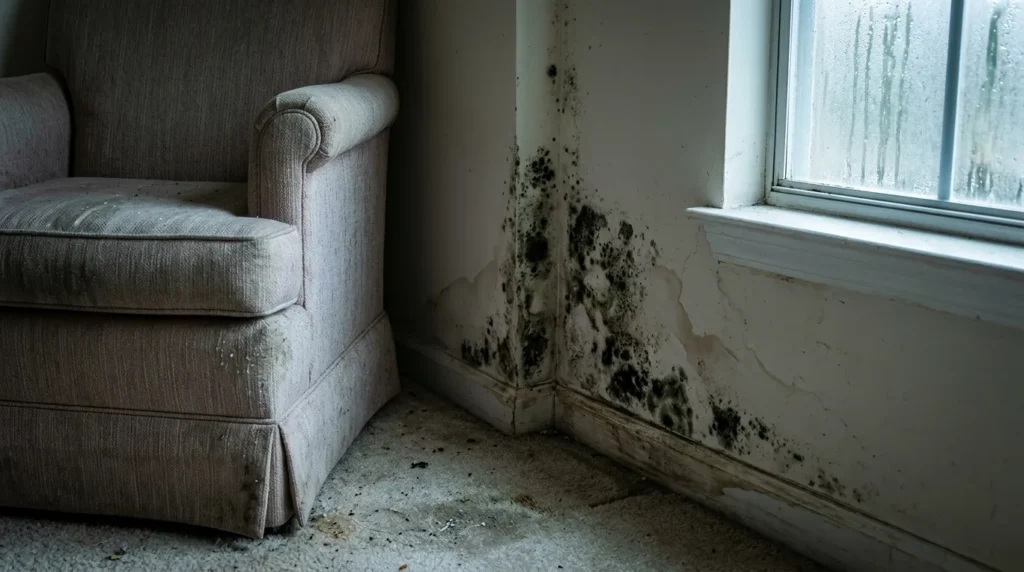
When your house feel humid even with ac on, it is not a problem you can afford to live with or put off until next season. Sustained indoor relative humidity levels above sixty percent create an ideal, aggressive breeding ground for biological hazards that directly threaten your family’s physical well-being.
Toxic Mold and Mycotoxin Accumulation
Mold spores exist naturally in the outdoor air, but they require a steady source of moisture, warmth, and organic material to settle, colonize, and grow indoors. When your air conditioner fails to control humidity, every surface in your home—from the drywall and wooden framing to your carpets, furniture fabrics, and clothing closets—becomes a potential mold incubator.
As mold colonies thrive in high-humidity environments, they release millions of microscopic spores and volatile organic compounds into your breathing air. Certain species, such as Stachybotrys chartarum (commonly known as black mold) and varieties of Aspergillus or Penicillium, produce toxic chemical compounds called mycotoxins.
Substained exposure to indoor mold and mycotoxins can cause chronic inflammatory response syndrome, severe respiratory distress, persistent headaches, cognitive fatigue, skin rashes, and recurring sinus infections. For individuals with compromised immune systems, infants, or the elderly, systemic mold growth caused by an unmanaged indoor microclimate can lead to deep-seated lung infections.
Dust Mite Proliferation
Dust mites are microscopic arachnids that live in household dust, bedding, carpets, and upholstered furniture. They are one of the most common triggers for year-round allergies and asthma attacks. Dust mites do not drink water; instead, they survive by absorbing moisture directly from the air around them.
Because of this physiological trait, dust mites cannot survive in environments where the relative humidity stays consistently below fifty percent. However, when your home remains damp and humid, dust mite populations explode exponentially. Their waste products and decaying bodies become airborne, leading to chronic allergic reactions, including persistent sneezing, watery eyes, nasal congestion, and severe nighttime coughing fits for sensitive individuals.
The Threat to Structural Safety and Home Integrity
Beyond the severe health implications, chronic indoor humidity is a slow, silent destroyer of residential property. High moisture levels in the air will eventually settle onto cooler structural surfaces, leading to condensation, wood decay, and material degradation that can permanently compromise your home’s safety and resale value.
Wood Rot and Structural Framing Failures
The structural integrity of most residential homes relies on wood framing, floor joists, and roof trusses. Wood is a hygroscopic material, meaning it acts like a sponge, naturally absorbing and releasing moisture to match the surrounding air.
When your house feel humid even with ac on week after week, the moisture content of your home’s structural wood begins to climb. If the moisture content of framing timber stays elevated for extended periods, wood-decay fungi take hold. These organisms feed on the cellulose fibers of the wood, causing it to soften, warp, crack, and ultimately lose its load-bearing capacity.
This can result in sagging floors, bowing walls, and compromised roof structures that require thousands of dollars in invasive structural repairs to fix.
Drywall Damage, Peeling Paint, and Flooring Buckling
High indoor humidity actively attacks your interior finishes long before structural framing failure becomes obvious. You might notice paint starting to blister, bubble, or peel away from the walls in rooms that do not even have water fixtures. This happens because moisture is trapped behind the paint film, breaking down the bond with the underlying drywall.
Drywall itself is highly susceptible to moisture damage. Extended exposure to humid air softens the gypsum core of the panels, causing them to sag, lose structural rigidity, and pull away from their fasteners.
Furthermore, hardwood flooring, engineered planks, and laminate materials are highly sensitive to relative humidity variations. When the air is saturated with water vapor, wooden floorboards expand tightly against one another, leading to cupping (where the edges of the boards rise higher than the center) or buckling, where entire sections of the floor lift completely off the subfloor.
How to Diagnose and Correct a Humid Home Environment
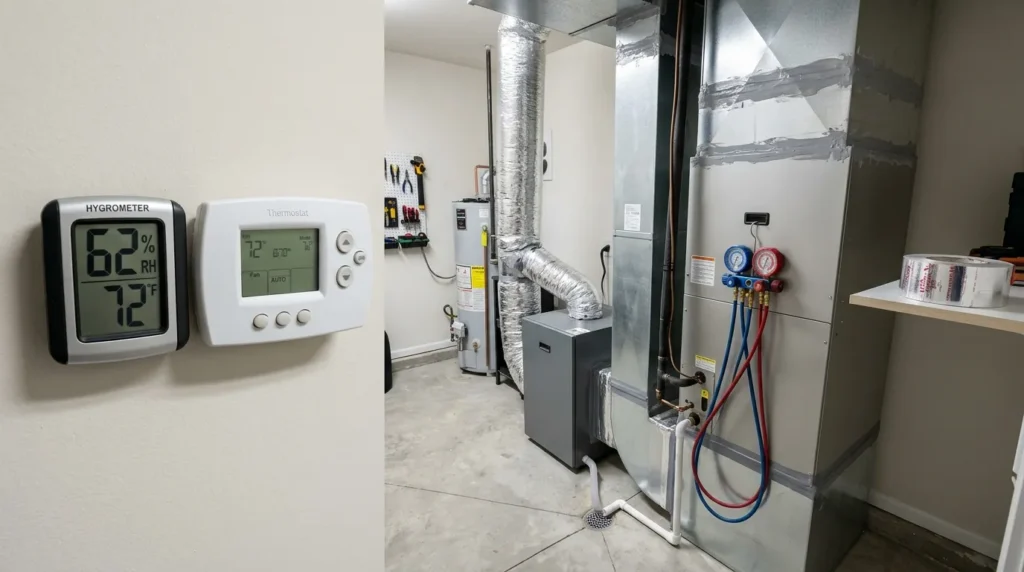
Resolving a situation where your house feel humid even with ac on requires a methodical diagnostic approach. Because the problem can stem from a mix of HVAC configuration errors, mechanical malfunctions, and structural envelope leaks, you need a clear strategy to identify the true root cause and apply permanent solutions.
Step 1: Monitor with a Hygrometer
You cannot manage what you do not measure. Before making any major structural changes or calling out an HVAC technician, purchase a few inexpensive digital hygrometers and place them in different areas of your home.
Track the readings over several days. Ideally, your indoor relative humidity should hover between thirty-five and fifty percent. If your hygrometers consistently read sixty percent or higher while your air conditioner is running, you have verified a systemic moisture control failure that requires immediate intervention.
Step 2: Check and Adjust Your Thermostat Settings
Take a close look at your thermostat interface. If your fan setting is currently set to “ON,” flip the switch to “AUTO” immediately. Monitor your home over the next forty-eight hours.
For many homeowners, this single, simple adjustment is enough to drop indoor relative humidity levels by five to ten percent, as it stops the system from continuously re-evaporating moisture off the indoor coil back into the living space.
Step 3: Schedule an HVAC Airflow and Sizing Evaluation
If your thermostat settings are correct but the air remains sticky, contact a certified HVAC professional to perform a comprehensive system audit. Ask them to verify your system’s total cooling capacity against a formal load calculation for your home’s specific square footage and insulation levels.
If your system is significantly oversized, a technician may be able to adjust the blower motor speed to slow down the airflow across the evaporator coil. A slower airflow keeps the air in contact with the freezing coil for a longer duration, which maximizes moisture removal during the cooling cycle. In extreme cases where an oversized unit is short-cycling severely, replacing the system with a properly sized unit or converting it to a multi-stage or variable-speed system may be the only permanent fix.
Step 4: Inspect and Seal Your Ductwork
Have a professional perform a duct leakage test to see if your system is pulling unconditioned, humid air into your living spaces. Sealing leaky duct joints with high-quality mastic paste or specialized foil tape prevents negative building pressure from developing.
Ensuring your return ducts are fully sealed guarantees that your air conditioner only processes air from inside your clean living environment, rather than conditioning the hot, humid void of an attic or crawlspace.
Step 5: Invest in a Whole-House Dehumidifier
In regions with extreme seasonal humidity, or in modern, tightly insulated homes that do not require long cooling cycles to maintain temperature, a standard air conditioner may simply lack the capacity to manage the latent moisture load on its own.
In these scenarios, integrating dedicated whole-house dehumidification equipment directly into your existing HVAC setup is a highly effective, systemic solution. These specialized units operate independently of your air conditioner. They pull air from your home, pass it over a dedicated refrigeration circuit optimized solely for moisture removal, and return crisp, dry air back into your ventilation system. This allows you to maintain perfect, healthy humidity levels even on mild, overcast, and sticky days when your air conditioner does not need to run at all. To begin mapping out these upgrades, you can coordinate an assessment via the Contact Us portal.
Prioritizing Indoor Environmental Quality
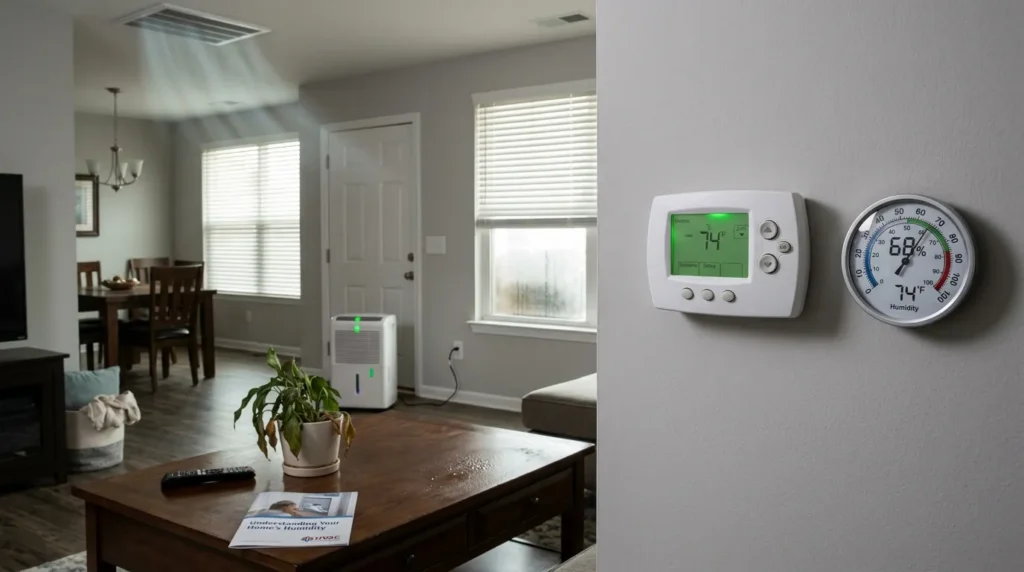
Your home should be a safe, healthy, and restorative shelter from the outside world. When your house feel humid even with ac on, it is an indicator that your indoor environmental quality has broken down. It is a sign that the mechanical and structural systems engineered to protect you are currently working against each other.
By recognizing that a sticky indoor climate is a complex, systemic issue affecting your health, comfort, and home safety, you can take proactive control of your living environment. Whether the fix requires a simple adjustment to your thermostat fan, a targeted duct sealing project, or the addition of a dedicated dehumidification system, addressing high indoor humidity is an investment that protects your property value and preserves your family’s long-term health. Turn off the continuous fan, measure your humidity levels, and consult with trusted professionals to restore comfort, safety, and balance back to your home.