

Every time you finish scrubbing your shower, you might notice a dull, hazy layer clinging to the glass doors and tiled walls. No matter how much elbow grease you exert or how many harsh chemical cleaners you apply, that stubborn film returns almost overnight. If you find yourself constantly scrubbing away soap scum, the root cause isn’t your cleaning routine—it’s the mineral content flowing through your home’s plumbing. Installing a whole-home water softener is the ultimate solution to eliminate soap scum at the source, preventing costly mineral damage to your pipes and expanding the operational lifespan of your household appliances.
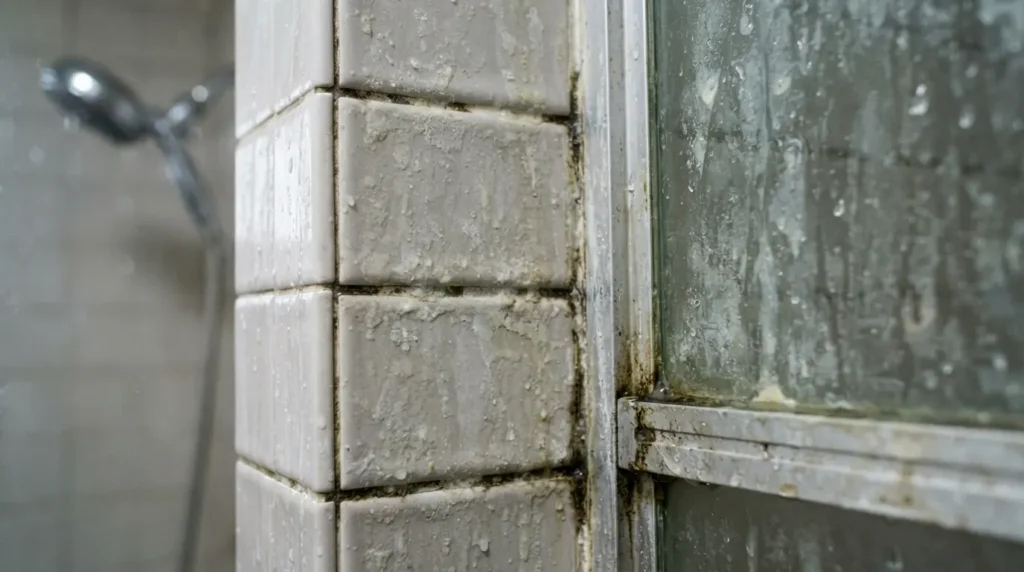
Many homeowners mistakenly believe that stubborn bathroom film, cloudy drinking glasses, and itchy skin after a shower are separate, unrelated household nuisances. In reality, these are clear indicators of hard water running through your taps. Understanding how mineral-heavy water affects your home, health, and wallet is the first step toward reclaiming your plumbing system and improving your daily quality of life. Exploring professional water filtration systems provides a comprehensive approach to correcting poor water quality across your entire property.
What Is Hard Water and Why Does It Cause Soap Scum?
Hard water contains elevated levels of dissolved minerals, primarily calcium ($Ca^{2+}$) and magnesium ($Mg^{2+}$). As groundwater flows through subterranean rock formations, limestone, chalk, and gypsum deposits, it naturally dissolves these mineral ions before reaching municipal water treatment facilities or private wells. While these minerals are generally safe for consumption, they wreak havoc on residential plumbing infrastructure and household cleaning routines.
The formation of soap scum is a basic chemical reaction. Standard soaps and cleansers are formulated using fatty acid salts (such as sodium stearate). When soap mixes with pure, soft water, it easily dissolves and creates a rich lather. However, when soap reacts with hard water, the positively charged calcium and magnesium ions bind with the fatty acid molecules in the soap.
$$\text{Sodium Stearate (Soap)} + \text{Calcium Ions} \rightarrow \text{Calcium Stearate (Soap Scum precipitate)} + \text{Sodium Ions}$$
Instead of dissolving in water, this chemical reaction creates calcium stearate—an insoluble, sticky precipitate commonly known as soap scum. This curdy white or grey substance clings aggressively to glass, porcelain, chrome fixtures, fiberglass, and even human skin.
The Hidden Impact of Hard Water on Your Daily Life
Before hard water causes catastrophic plumbing failures, it causes dozens of small daily frustrations. Recognizing these early signs can help you address water quality issues before minor annoyances turn into major structural repairs.
1. Persistent Dry Skin and Brittle Hair
When you bathe in hard water, the same soap scum reaction occurring on your shower walls takes place directly on your skin and scalp. The sticky mineral residue coats your epidermis, stripping away natural protective oils and clogging pores. This often results in:
- Chronic dry, itchy skin or flare-ups of conditions like eczema and psoriasis.
- Dull, lifeless hair that feels stiff, frizzy, or weighed down.
- Scalp irritation, dandruff, and color-faded hair treatments due to mineral coating.
2. Chalky Limescale on Fixtures and Faucets
As hard water evaporates on chrome, stainless steel, or matte black faucets, it leaves behind crusty, white calcium carbonate deposits known as limescale. Over time, limescale restricts water flow through aerators and showerheads, causing uneven spray patterns and diminished water pressure.
3. Faded Clothes and Scratchy Linens
Washing clothes in hard water prevents laundry detergent from dissolving properly, requiring up to 50% more detergent to achieve a standard clean. The mineral deposits get trapped within fabric fibers, causing bright colors to fade into dull grays, weakening towel absorbency, and leaving bedsheets feeling rough and scratchy against your skin.
4. Spotty Dishes and Glassware
If your dishwasher leaves behind a chalky white film or etched spots on clean glassware, hard water is the culprit. As hot water evaporates during the dry cycle, dissolved minerals precipitate onto flatware and dishes, making them look dirty even right after washing. Consulting with experienced local contractors on My Family HVAC can help you identify comprehensive solutions for indoor environmental and water challenges.
How Hard Water Destroys Your Plumbing and Appliances From Within
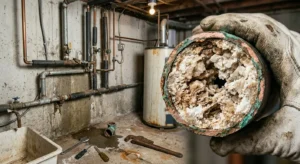
While soap scum on shower glass is annoying, the most destructive damage caused by hard water happens where you cannot see it: inside your walls, pipes, and home appliances.
Hard Water Flow ──> Mineral Precipitation ──> Limescale Accumulation ──> Pipe Corrosion / Reduced Flow ──> Premature Appliance Failure
Pipe Constriction and Scale Accumulation
As hard water travels through copper, galvanized steel, or PEX piping, temperature changes and pressure drops cause calcium and magnesium to settle along the interior walls of your pipes. Over years of continuous exposure, this mineral scaling builds up in concentric layers, narrowing the internal diameter of your pipes just like arterial plaque constricts blood flow.
This restriction causes several critical issues:- Decreased Water Pressure: Flow rates drop significantly across all taps and showers simultaneously.
- Corrosion and Pinhole Leaks: Trapped mineral deposits create localized chemical reactions that pit metallic pipe interiors, causing premature pinhole leaks.
- Increased Strain on Plumbing Joints: Higher pumping pressure forced through narrowed pipes puts added stress on joints, elbows, and valves.
Accelerated Appliance Deterioration
Your water heater, dishwasher, washing machine, and coffee maker rely on clear, efficient fluid pathways to operate properly. Hard water drastically shortens their operational lifespans.
| Appliance | Impact of Hard Water | Operational Consequence |
| Tank Water Heater | Sediment layer forms at bottom of the heating element | 25-40% increase in energy costs;| tank burnout and cracking |
| Tankless Heater | Rapid scale clogging in narrow heat exchanger tubes | Thermal overload shut-off; frequent descaling flushing |
| Washing Machine | Scale buildup on internal pumps, solenoid valves, and drums | Agitator motor burnout; premature hose leaks |
| Dishwasher | Clogged spray arm nozzles; heating element burnout | Reduced wash effectiveness; heating element replacement |
Water heaters suffer the worst damage from hard water. When water is heated, minerals precipitate rapidly. In tank-style water heaters, calcium scales form a thick thermal insulating layer at the bottom of the tank. The burner must then work twice as hard to heat water through this mineral layer, dramatically increasing energy bills and causing the metal tank bottom to overheat and crack. If you suspect your heating or water heating equipment is underperforming due to scale, reviewing available options on My Family HVAC offers reliable guidance on equipment maintenance.How a Water Softener Works: The Ion Exchange Process
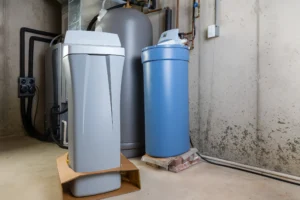
A whole-home water softener is an automated filtration appliance designed specifically to strip calcium and magnesium ions out of your incoming water supply before it ever enters your plumbing system.
The Science Behind Ion Exchange
Most modern water softeners operate using a physical-chemical process called ion exchange. The system consists of two primary tanks: a mineral tank housing specialized resin beads and a brine tank containing concentrated sodium chloride (salt).
 Incoming Hard Water (Ca²⁺, Mg²⁺)
               │
               ▼
   ┌───────────────────────┐
   │   Water Softener      │
   │    Resin Bed          │ <--- Resin holds Sodium (Na⁺) ions
   └───────────────────────┘
               │
               ├─► Calcium & Magnesium attached to resin
               ├─► Sodium released into water
               ▼
  Conditioned Soft Water (Na⁺)
- The Mineral Tank: Contains millions of tiny, food-grade polystyrene resin beads carrying a negative electrical charge. These beads are initially coated with positively charged sodium ($Na^+$) or potassium ($K^+$) ions.
- The Exchange Mechanism: As hard water passes through the resin tank, the strong positive charges of calcium ($Ca^{2+}$) and magnesium ($Mg^{2+}$) ions are attracted to the negatively charged resin beads.
- The Swap: The resin holds onto the calcium and magnesium, releasing the weaker sodium ions into the water stream in exact proportion.
- Regeneration Cycle: Over time, the resin beads become saturated with calcium and magnesium. The system automatically performs a regeneration cycle, flushing the resin bed with concentrated saltwater from the brine tank. The high concentration of sodium forces the calcium and magnesium off the resin and washes them harmlessly down the drain, resetting the unit for continuous operation.
To learn more about integrating softening technology into complete home treatment setups, explore the details on water filtration systems.
The Financial Benefits: How a Water Softener Pays for Itself
While installing a whole-home water softener requires an upfront investment, it is one of the few home upgrades that delivers a direct financial return on investment (ROI). Softening your water generates measurable savings across several categories:
1. Lower Energy Bills
According to studies by the Water Quality Research Foundation (WQRF), water heaters operating on soft water maintain their original factory efficiency rating over a 15-year lifespan. Conversely, water heaters using hard water suffer up to a 48% loss in heating efficiency, adding hundreds of dollars per year to your gas or electric utility bills.
2. Reduced Cleaning Product Consumption
Because soft water allows soaps, detergents, and shampoos to lather effortlessly without forming soap scum, you can reduce your cleaning product usage by 50% or more.
- Laundry Detergent: Use half the recommended dose per load while achieving cleaner clothes.
- Dishwashing Soap: Eliminate the need for expensive rinse aids and hard-water dish additives.
- Body Washes & Shampoos: A small drop yields a rich, luxurious lather.
3. Extended Appliance Lifespan
By preventing internal scale accumulation, a water softener protects dishwashers, washing machines, ice makers, and water heaters from premature breakdowns, pushing their operational life toward maximum manufacturer estimates.
Average Appliance Lifespan Comparison:

Hard Water:  [■■■■■■■] 5-7 Years
Soft Water:  [■■■■■■■■■■■■■] 10-13+ Years
4. Avoided Plumbing Repairs
Preventing pipe corrosion, valve failures, and re-piping needs saves homeowners thousands of dollars in emergency plumbing bills over a decade.
Types of Water Conditioning Systems Explained
Depending on your water quality, budget, and ecological preferences, several treatment technologies exist today. Selecting the right configuration depends on whether your main goal is mineral removal, sediment filtering, or scale control.
                 ┌─────────────────────────────────────────┐
                 │       Water Treatment Options           │
                 └────────────────────┬────────────────────┘
                                      │
         ┌────────────────────────────┴────────────────────────────┐
         ▼                                                         ▼
┌─────────────────────────┐                               ┌─────────────────────────┐
│ Salt-Based Softener     │                               │ Salt-Free Conditioner   │
├─────────────────────────┤                               ├─────────────────────────┤
│ • Removes Ca²⁺ & Mg²⁺   │                               │ • Alters mineral structure│
│ • Eliminates soap scum  │                               │ • Does not soften water │
│ • Extends appliance life│                               │ • Reduces scale cling   │
└─────────────────────────┘                               └─────────────────────────┘
1. Salt-Based Ion Exchange Water Softeners
- How it works: Uses resin beads and salt brine to remove hard minerals completely.
- Best for: Medium to severe hard water conditions.
- Key Benefits: Completely eliminates soap scum, protects pipes, and leaves skin feeling smooth.
2. Salt-Free Water Conditioners (Template Assisted Crystallization)
- How it works: Uses TAC media to transform dissolved minerals into microscopic crystals that won’t stick to pipes.
- Best for: Mild hard water areas where salt discharge is restricted by local ordinance.
- Key Benefits: No salt replenishment required, no wastewater produced; however, it does not eliminate soap scum or lower water hardness levels.
3. Dual-Tank Water Softeners
- How it works: Features two mineral tanks so one tank can regenerate while the other continues providing soft water to the household.
- Best for: Large families or homes with high continuous water usage.
- Key Benefits: Uninterrupted 24/7 soft water supply.
Integrating these setups alongside specialized whole-house physical filters creates a complete defense system. Discover options for your home by reviewing water filtration systems.
Step-by-Step Guide: How to Test Your Home’s Water Hardness
Determining whether you need a water softener starts with assessing your water’s mineral concentration, measured in Grains Per Gallon (GPG) or Parts Per Million (PPM/mg/L).
Hard Water Severity Scale:

0 - 1.0 GPG   (0 - 17.1 PPM)   ──> Soft Water
1.0 - 3.5 GPG (17.1 - 60 PPM)  ──> Slightly Hard
3.5 - 7.0 GPG (60 - 120 PPM)   ──> Moderately Hard
7.0 - 10.5 GPG (120 - 180 PPM) ──> Hard Water (Softener Recommended)
10.5+ GPG     (180+ PPM)       ──> Very Hard Water (Softener Essential)
1.Collect a Fresh Water Sample:Obtain pure water before any filtration.
Turn on a cold water faucet that does not pass through existing filters. Let it run for 30 seconds, then fill a clean glass container.
2.Perform a Quick Soap Bottle Test: A simple initial DIY check.
Fill a clear plastic bottle halfway with your water sample. Add 10 drops of pure liquid soap (not detergent). Cap tightly and shake vigorously for 10 seconds.
- Result: If the water creates thick, lasting suds and remains clear below, your water is relatively soft. If it creates minimal bubbles and turns cloudy/milky, you have hard water.
3.Use Liquid Dropper Test Kits: Accurate quantitative measurement.
Purchase a liquid titration test kit. Fill the test tube to the designated line, add indicator drops according to instructions, and count the drops required until the sample changes color. The drop count corresponds directly to your water’s hardness in Grains Per Gallon (GPG).
4.Schedule Professional Water Testing: Comprehensive laboratory analysis.
Contact a professional water technician to conduct an in-home analysis. A technician checks not only hardness levels but also pH balance, iron content, chlorine, and total dissolved solids (TDS) to ensure your softening unit is sized correctly.
To discuss professional water testing and system sizing with expert technicians, visit My Family HVAC.
Maintenance Tips to Keep Your Water Softener Working Perfectly
A high-quality water softener can last 15 to 20 years with simple, routine maintenance. Follow these essential practices to maintain optimal system performance:
- Check Salt Levels Monthly: Keep your brine tank at least half full of high-purity salt pellets. Ensure the salt level remains at least 3 to 4 inches above the water level.
- Break Up Salt Bridges: In humid environments, salt can form a hard crust inside the brine tank (a salt bridge), preventing the brine solution from mixing. Gently break up any crust using a broom handle.
- Clean the Resin Bed Annually: Iron, manganese, and organic matter can foul resin beads over time. Add an iron-clearing resin cleaner to your brine tank every 6 to 12 months to maintain maximum ion exchange capacity.
- Inspect the Brine Well and Valve Assembly: Ensure the safety float assembly moves freely and clean the injector nozzle periodically to prevent clogging.
Frequently Asked Questions
Will a water softener make my drinking water taste salty?
No. While a water softener uses sodium ions to replace hard minerals, the actual amount of sodium added to softened water is minimal. On average, a glass of softened water contains less sodium than a single slice of white bread. However, if you are on a strict low-sodium diet, you can install a reverse osmosis drinking system at your kitchen sink or use potassium chloride pellets in place of traditional salt.
What is the difference between a water filter and a water softener?
A water filter removes contaminants like chlorine, sediment, heavy metals, pesticides, and volatile organic compounds (VOCs) to improve safety and taste. A water softener specifically targets and removes dissolved calcium and magnesium minerals to prevent scale buildup and soap scum. Many homeowners combine both systems for comprehensive water quality.
Can a water softener clear out existing scale in my pipes?
Yes! Once soft water begins flowing through your plumbing, it gradually dissolves existing calcium carbonate scale deposits lining your pipes and heating elements over time, helping restore original water flow and thermal efficiency.
Say Goodbye to Soap Scum for Good
Living with hard water means constantly fighting a losing battle against soap scum, clogged showerheads, faded laundry, and prematurely failing appliances. By installing a whole-home water softener, you eliminate hard water minerals right at your point of entry, protecting your plumbing infrastructure, lowering your monthly energy bills, and keeping your home’s surfaces sparkling clean.
Ready to transform your home’s water quality and protect your plumbing investment? Explore advanced whole-home water filtration systems or connect directly with trusted local specialists through My Family HVAC to schedule your professional water evaluation today.